
Is Quartz or Marble Better for Bathroom Shower Walls in DFW?
Quartz is generally the better choice for DFW homeowners who want durable, low-maintenance shower walls, while marble is ideal for homeowners who prioritize one-of-a-kind natural beauty and are comfortable with additional care. Quartz is nonporous and does not require sealing, while marble is a natural stone that can perform well in showers but requires more careful cleaning and maintenance.
Choosing between the two ultimately comes down to how you want your bathroom to look and how much maintenance you are willing to take on. At Moreno Granite, we help homeowners throughout Dallas and Fort Worth select beautiful stone and engineered surfaces that complement their homes and lifestyles. With more than 10 years of experience serving DFW, our family-owned and operated team combines precise fabrication, professional installation, and personalized customer care. Whether you are remodeling a primary bathroom in Dallas, creating a spa-inspired shower in Plano, or updating a home in another part of the Metroplex, understanding how quartz and marble perform in a wet environment can help you make a confident investment.
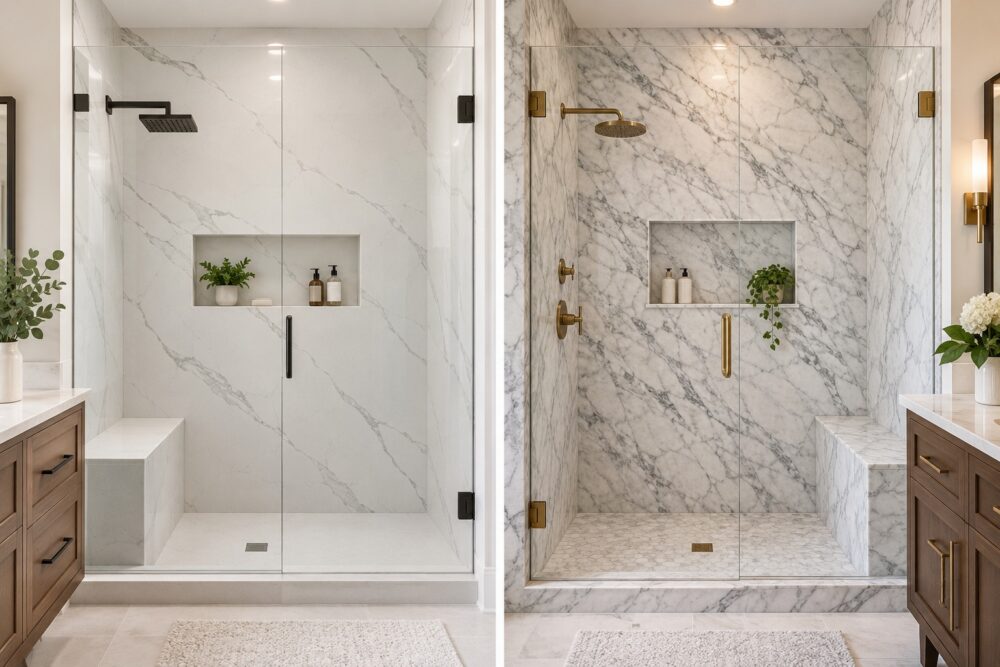
Quartz vs. Marble Shower Walls: Which Material Fits Your Bathroom?
Quartz and marble can both create an upscale shower, but they achieve that result in different ways. Marble is a quarried natural stone, while the quartz surfacing commonly used in bathrooms is an engineered material made using natural quartz along with pigments and binders.
According to the Natural Stone Institute, many varieties of marble are suitable for wet-area applications, including showers. Engineered quartz manufacturers such as Cambria also specifically offer quartz slabs for shower-wall installations.
Is Quartz a Good Material for Shower Walls?
Yes. Quartz is particularly well suited to shower walls because it provides a nonporous, nonabsorbent surface with minimal routine maintenance.
Unlike natural marble, engineered quartz does not require regular sealing. Large-format quartz slabs can also minimize or eliminate the numerous grout lines associated with traditional tile installations. Cambria notes that its quartz shower surfaces resist moisture and do not require sealing, polishing, or reconditioning.
Some of the biggest advantages include:
- Nonporous and nonabsorbent construction
- No routine sealing required
- Excellent resistance to staining
- Fewer grout lines when installed as large slabs
- Easy everyday cleaning
- Wide variety of colors and patterns
- Marble-inspired designs without marble’s maintenance requirements
Quartz can be particularly appealing for busy DFW households where homeowners want a polished, high-end bathroom without adding another surface to a regular sealing schedule.
Can You Use Natural Marble in a Shower?
Yes, many types of marble can be used successfully in showers when the material, installation method, waterproofing system, and maintenance routine are appropriate. The Natural Stone Institute specifically identifies many marbles as suitable for wet areas, including shower applications.
Marble’s biggest advantage is authenticity. Every slab was formed naturally, so its veining, movement, and color variations are genuinely unique. For homeowners creating a traditional, European-inspired, or luxury bathroom, that natural variation can be difficult to duplicate.
Marble does require more attention. Because marble is primarily composed of calcium carbonate, the Natural Stone Institute warns that it is sensitive to acidic solutions. Appropriate stone-safe cleaners should be used instead.
For marble shower walls, homeowners should be prepared to:
- Follow the recommended sealing schedule for the specific stone and installation
- Use pH-neutral or stone-safe cleaning products
- Avoid acidic and abrasive cleaners
- Remove soap and mineral buildup carefully
- Use a squeegee to reduce water and soap residue
- Follow the fabricator’s care recommendations
The Natural Stone Institute recommends using a squeegee after showering to help minimize soap scum in natural-stone wet areas.
Which Is Easier to Maintain, Quartz or Marble?
Quartz is typically easier to maintain than marble. This is one of the most important differences for homeowners comparing quartz vs. marble shower walls.
Engineered quartz’s nonporous surface means it does not need the periodic sealing associated with many natural stones. Cambria, for example, recommends cleaning its quartz surfaces with warm water, a soft cloth, and mild soap when needed.
Marble requires a more deliberate cleaning routine because acids and inappropriate cleaners can damage its surface. This does not mean marble is impractical for a shower. It simply means homeowners should understand the care requirements before selecting it.
For a high-use primary bathroom or children’s bathroom, quartz often provides the easier ownership experience. For a statement bathroom where authentic natural stone is the priority, marble may be worth the extra care.
Does Quartz Look as Luxurious as Marble?
Modern quartz can closely recreate the general appearance of marble, but it cannot duplicate the natural uniqueness of a quarried marble slab.
Quartz manufacturers now produce designs with dramatic veining, soft movement, warm whites, cool grays, and other details inspired by natural stone. Quartz also provides greater pattern consistency, which can be useful when coordinating shower walls with a bathroom vanity, backsplash, or other surfaces.
Marble offers variation that cannot be manufactured exactly. No two natural slabs are identical, which makes marble particularly attractive when the shower is intended to become the visual centerpiece of the bathroom.
Consider the look you want:
Choose quartz if you prefer:
- Consistent patterns and colors
- Contemporary or streamlined bathrooms
- Large, uninterrupted shower surfaces
- Marble-inspired looks with easier upkeep
Choose marble if you prefer:
- Authentic natural veining
- One-of-a-kind stone patterns
- Traditional or timeless luxury
- Natural variation and character
What Should DFW Homeowners Consider Before Choosing?
DFW homeowners should compare maintenance, design, fabrication, installation, and the specific product’s suitability for shower applications before choosing a surface.
From homes in Dallas and Garland to communities throughout Plano, Frisco, McKinney, Fort Worth, and the surrounding Metroplex, bathroom styles and household needs vary considerably. A low-maintenance quartz shower may make sense for a busy family, while a custom marble shower may be the centerpiece of a luxury primary suite.
The installation itself is just as important as the surface selection. Wet areas have specialized requirements. The Natural Stone Institute’s wet-area design guidance addresses considerations including waterproofing, stone porosity, anchorage, floor slope, and other details for stone shower installations.
Professional measurement, fabrication, and installation are therefore essential when creating a slab shower surround.
Quartz or Marble: Which Should You Choose for Your DFW Shower?
For most homeowners seeking the easiest combination of durability, moisture resistance, and low maintenance, quartz is the practical choice for shower walls. Its nonporous construction and lack of routine sealing requirements make everyday bathroom care simpler.
Marble is the better fit when authentic natural stone and unique visual character are the top priorities. With appropriate installation and care, marble can create a striking shower that brings natural elegance to the bathroom.
Neither material is automatically right for every project. The best choice depends on your preferred appearance, maintenance expectations, budget, and the demands of the specific bathroom.
Frequently Asked Questions About Quartz and Marble Showers
Does quartz need to be sealed in a shower?
No. Engineered quartz products such as Cambria are nonporous and do not require sealing. Always follow the care and installation instructions for the specific quartz brand selected for your project.
Does marble need to be sealed in a shower?
Many marble shower installations benefit from an appropriate penetrating sealer, but requirements vary by stone and installation. Ask your stone fabricator or installer about the correct sealing and maintenance schedule for your specific marble.
Can quartz shower walls look like marble?
Yes. Quartz is available in numerous marble-inspired designs featuring veining and natural-looking movement. It provides a similar design direction while offering a nonporous, lower-maintenance surface.
Is marble too high maintenance for a shower?
Not necessarily. Many marbles are suitable for wet areas, according to the Natural Stone Institute. Marble simply requires more careful cleaning and maintenance than nonporous engineered quartz.
Ready to Choose the Perfect Surface for Your Bathroom?
Transform your DFW bathroom with a shower surface designed around your style, space, and maintenance preferences. Moreno Granite can help you compare quartz and marble options, select the right material, and create a finished bathroom that combines beauty with everyday functionality. Contact Moreno Granite to get started on your bathroom project today.